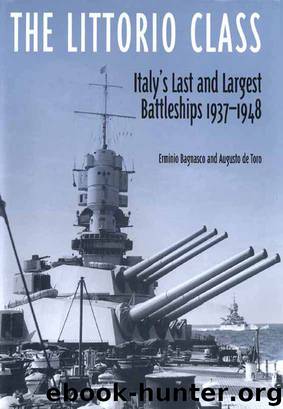
The Littorio Class by Erminio Bagnasco
Author:Erminio Bagnasco
Language: eng
Format: epub
ISBN: 9781473819474
Publisher: Seaforth Publishing
Vittorio Veneto, Admiral Iachino’s flagship, and Cesare were moored at the Luigi Razza quay, as well as Pola, Zara, and Gorizia (Fiume had been transferred to La Spezia three days earlier for repairs to her engines) moored at the Italo Balbo pier, and eleven destroyers of VII, IX and XI Flotillas. There were also two large passenger liners present, Giulio Cesare and Lombardia, and the hospital ship Arno. The attack was carried out by nine Wellingtons in two waves: the first consisted of four aircraft, with the naval vessels and port installations as their targets, on the evening of the 14th; the second wave of five aircraft, with the airport and rail yards as their targets, hit during the very early hours of the 15th. Weather conditions during the first attack were excellent, with a clear sky, calm wind and full moon at 60° on the horizon. During the second attack, however, the sky was cloud covered at about 800 metres, with the moon at its zenith and a light wind at altitude. Both attacks approached from the sea and were carried out without the use of flares at altitudes estimated between 1,000 and 2,000 metres, with repeated runs over the targets.
During the first attack, the Dicat (Difesa Contraerei Territoriale = Territorial Anti-aircraft Defence) reacted immediately after the alarm was sounded (20.54), when the enemy aircraft were already over the target. A few minutes later (21.04) the ships in port joined in with barrage fire from their automatic weapons, with the fire lasting on an intermittent basis until 21.55.The alarm for the second attack was sounded at 00.14 on the 15th and the Dicat opened fire at 00.19. After 00.40 the ships opened up again with barrage fire, with the 90mm guns aboard Vittorio Veneto also joining in. Overall, the anti-aircraft defence was confused and ineffective and the ships only spotted the attacking aircraft three times. The ships did not use their fog-generating equipment, and there were no such operational installations ashore.
The damage to the port installations and to the city was of little account. The damage to the ships, against which 250lb (113.5kg) SAP bombs were used, was more serious. The worst damage was sustained by Pola which was hit by two bombs and, incredibly, was in danger of sinking because of extensive flooding and the loss of electrical power. The tanker Laura Corrado was also damaged, and the motor-sailer V SS-Immacolata III was sunk but later refloated. The passenger ship Giulio Cesare, moored at Italo Balbo pier, suffered slight damage from an anti-aircraft shell. The bombing made the inadequacy of the anti-aircraft defences of Naples abundantly clear and Supermarina decided to relocate the major ships until such time as the defences had been improved.
On the afternoon of 15 December the two battleships and the remaining cruisers of 1st Division along with their respective destroyer flotillas left Naples for La Maddalena. Similar precautions were taken at Messina for 3rd Division. On 15 December Trieste and Trento left the base on the strait, leaving only Bolzano at Cagliari.
Download
This site does not store any files on its server. We only index and link to content provided by other sites. Please contact the content providers to delete copyright contents if any and email us, we'll remove relevant links or contents immediately.
| Africa | Americas |
| Arctic & Antarctica | Asia |
| Australia & Oceania | Europe |
| Middle East | Russia |
| United States | World |
| Ancient Civilizations | Military |
| Historical Study & Educational Resources |
The Radium Girls by Kate Moore(12035)
100 Deadly Skills by Clint Emerson(4931)
Rise and Kill First by Ronen Bergman(4797)
The Templars by Dan Jones(4695)
The Doomsday Machine by Daniel Ellsberg(4493)
The Rape of Nanking by Iris Chang(4224)
Killing England by Bill O'Reilly(4008)
Stalin by Stephen Kotkin(3973)
Hitler in Los Angeles by Steven J. Ross(3949)
12 Strong by Doug Stanton(3554)
Hitler's Monsters by Eric Kurlander(3348)
Blood and Sand by Alex Von Tunzelmann(3207)
The Code Book by Simon Singh(3197)
Darkest Hour by Anthony McCarten(3135)
The Art of War Visualized by Jessica Hagy(3014)
Hitler's Flying Saucers: A Guide to German Flying Discs of the Second World War by Stevens Henry(2759)
Babylon's Ark by Lawrence Anthony(2685)
The Second World Wars by Victor Davis Hanson(2529)
Tobruk by Peter Fitzsimons(2521)
